


Hero Roles, Skills & Star Progression
Build a dependable five-hero squad, understand star breakpoints and spend skill medals where they create a real result.
Build one main squad first. Put two Defence heroes in front and Attack or Support heroes behind them. Raise the five together by level, but concentrate universal shards and skill medals on the heroes and breakpoints that change the squad’s performance.
Start with the three things people confuse
Every hero has a battlefield role, a troop type and a rarity. They are separate decisions:
| Hero label | What it tells you | What to do with it |
|---|---|---|
| Defence | The hero is designed to absorb pressure or protect the team. | Normally place it in the front row and prioritise survival. |
| Attack | The hero’s main job is dealing damage. | Protect it in the back row and invest in its reliable damage skills. |
| Support | The hero improves the squad through buffs, healing, control or protection. | Place it behind the frontline and judge the effect on the whole team. |
| Tank / Aircraft / Missile | The hero’s troop type, used for counters and lineup bonuses. | Build around one main type before funding a second full squad. |
| UR / SSR / SR | The hero’s rarity and the type of shards used for progression. | Do not replace a developed hero merely because a higher-rarity portrait appears. |
Build the five-hero formation first
A standard formation has two exposed positions at the front and three protected positions behind them. Last War’s official guidance places Defence heroes in front, with Attack and Support heroes in the back. That is the safe starting point; battle reports tell you when a lane needs adjusting.
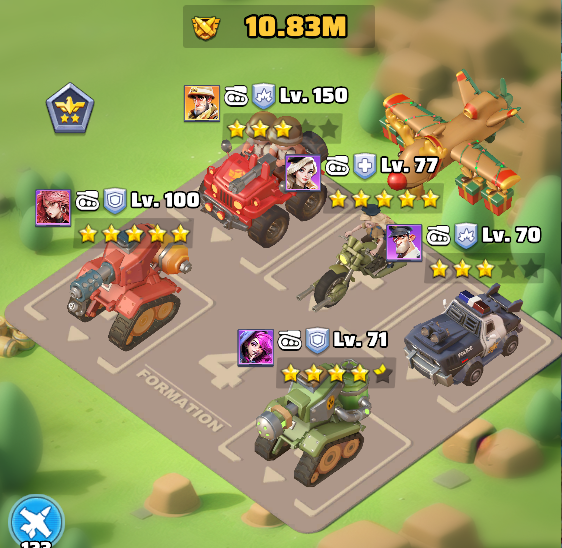
A dependable starting structure
- Front left and front right: two Defence heroes capable of surviving the opening pressure.
- Back row: the main attacker, a second damage dealer and either another attacker or a Support hero.
- Strongest lane: place the tougher defender opposite the enemy lane causing the earliest collapse.
- Protected damage: keep the attacker receiving your best gun, chip and skill investment behind a stable defender.
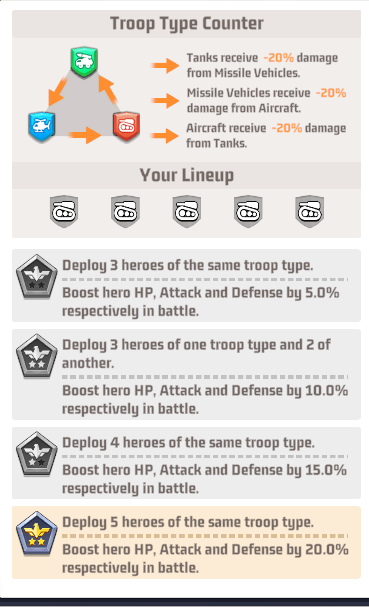
Tank, Aircraft and Missile also form a counter cycle: Tank counters Missile, Missile counters Aircraft, and Aircraft counters Tank. A matching lineup grants +5% HP, Attack and Defence with three heroes of one type, +15% with four, and +20% with all five. A mixed squad can still be correct, but the hero you add must repay the formation bonus you lose.
What each upgrade actually changes
| Upgrade | Main benefit | Best practical rule |
|---|---|---|
| Hero level | Raises base combat statistics and troop capacity. | Keep the active five close to the current useful cap; do not level the whole roster equally. |
| Stars | Raises attributes and opens or strengthens major skill breakpoints. | Finish a meaningful breakpoint on one core hero before starting several side projects. |
| Skills | Improves the hero’s actual battle function. | Upgrade the skill that performs the hero’s job; equal skill levels are rarely the best use of medals. |
| Gear | Adds offensive or defensive statistics and powerful tier effects. | Best gun and chip usually go to the main attacker; armour and radar usually favour the frontline. |
| Exclusive Weapon | Adds hero-specific effects and milestone bonuses where available. | Only fund weapons for heroes in the established plan, and read every live milestone before spending. |
Stars: plan for a finish line
Star progression uses hero-specific shards or universal shards of the matching rarity. Community references document the standard five-star path below. Treat the numbers as a planning baseline and confirm the requirement shown on your live hero screen before committing resources; events, future systems or balance changes can alter what you see.
| Target | Shards for this star | Cumulative shards | Planning meaning |
|---|---|---|---|
| 1 star | 25 | 25 | Early development; avoid judging the finished hero here. |
| 2 stars | 50 | 75 | The hero begins opening its broader skill progression. |
| 3 stars | 100 | 175 | A practical early breakpoint for a hero you actively use. |
| 4 stars | 300 | 475 | A major breakpoint and the Academy’s first priority for the main lineup. |
| 5 stars | 500 | 975 | Powerful but expensive; compare the gain with bringing another core hero to four stars. |
Each star is divided into smaller tiers, so partial investment still adds progress. The strategic mistake is not adding a tier—it is leaving premium universal shards scattered across several heroes with no important breakpoint close enough to finish.
If your main attacker is 40 shards from four stars and a new bench hero is 475 shards from the same point, finish the attacker unless the new hero is part of a deliberate replacement plan. One completed breakpoint normally helps today; two unfinished projects do not.
Skills: upgrade the job, not the row
Skill medals become scarce as skill levels rise. Do not press every available upgrade from left to right. Open the skill details, read what changes at the next level, and ask whether it improves the hero’s main responsibility in the mode you are building for.
| Role | Usually prioritise | Delay when |
|---|---|---|
| Main attacker | The active damage skill, then the passive that scales reliable damage or attack. | A skill only improves a condition that rarely occurs in your current formation. |
| Frontline defender | Damage reduction, shields, HP, Defence and protection that keeps the formation alive. | The upgrade adds minor personal damage while the hero still dies first. |
| Support | The team buff, healing, control or mitigation that affects the squad’s result. | The skill improves personal damage but not the reason the hero occupies the slot. |
| Temporary or bench hero | Only the inexpensive levels needed for present use. | The medals would delay a meaningful breakpoint on the permanent main five. |
Community priority lists can be useful starting points, but heroes have different kits and some exclusive weapons change how those kits work. The live skill description is the final authority. After a major skill upgrade, repeat the same battle and confirm that damage, survival or support contribution improved.
A sensible investment order
- Name the main five. Choose the squad used for everyday progression, alliance battles and most competitive content.
- Fix the formation. Two proper frontline heroes must survive long enough for the back row to work.
- Keep useful levels moving. Raise the main five before spending Hero EXP on heroes that do not enter battle.
- Take the core five towards four stars. Give the primary attacker or failing frontline priority when a breakpoint is close.
- Concentrate skill medals. Fund the skills responsible for damage, survival or team support instead of maintaining matching numbers.
- Only then widen the roster. Develop a second troop-type formation when the first squad is stable rather than cannibalising it every week.
Three spending styles
- Free-to-play or very light spend: commit to one troop type, protect universal UR shards, and accept that a developed SSR can remain useful while its UR replacement catches up.
- Moderate spend: finish four-star breakpoints across the core squad before chasing multiple five-star heroes or several exclusive weapons.
- Competitive spend: build the main formation to its planned breakpoints, then develop the counter formation as a separate project with its own frontline, skills and gear plan.
How to decide who gets the next upgrade
Use battle evidence instead of the red notification dot:
- A defender dies in the opening seconds: raise its survival skill, level, armour or radar; also test the other front lane.
- The squad survives but times out: improve the main attacker’s active skill, offensive gear and relevant research.
- A back-row hero dies first: inspect the defender in front of it and change lanes before spending.
- A new UR hero lowers the result: restore the developed hero and build the replacement until its stars and skills are ready.
- Several heroes are one tier from different stars: finish the hero whose next complete star solves the current bottleneck.
Common mistakes
- Levelling every hero: Hero EXP placed on an unused roster does not help the squad clearing today’s content.
- Putting Attack heroes in front: high damage does not compensate for losing the hero before its important skills fire.
- Making all skills equal: medal costs rise while low-impact skills consume the materials needed by the hero’s defining ability.
- Starting too many five-star projects: the final star is expensive; four-star strength across the main five can be a better immediate return.
- Replacing by rarity alone: a newly unlocked UR hero can be weaker today than a properly developed SSR.
- Copying one universal priority list: PvP, bosses and campaign stages do not always reward the same skill or formation.
Use the Academy planners
Open the Hero Upgrade Priority Planner →
Enter the five heroes you actually use and record their role, stars, skills, gear and exclusive weapon status. The planner is most useful when you give every project a specific finish line.
Open the Exclusive Weapon Planner →
References and evidence
- Official Last War Support — How to Build the Best Squad (formation, counters, lineup bonuses and four-star priority; updated 30 March 2026).
- Last War Tutorial — Heroes (community reference for roles, star tiers and shard totals).
- Last War Wiki — Hero Skill Upgrade Priorities (community starting priorities; hero-specific exceptions apply).
- Last War Wiki — Skill Medal (community reference for skill-medal progression).
Last evidence review: 25 July 2026. Official claims are labelled in the text; community figures should always be checked against the current in-game screen after patches.
Record this mission file
Your completion is saved privately in this browser. Sign in as a member to sync it between devices.
Was this guide helpful?
Your feedback helps us improve the next update.